Dubai Real Estate Data
Dubai real estate data is the recorded and calculated information that describes the Dubai property market. Dubai real estate data begins with official transactions, registered tenancy contracts, projects, land, buildings, units and valuations.
Dubai Land Department records and documents Dubai real estate transactions. Ejari registers Dubai tenancy contracts. These records show registered sales and contractual rents. Correct classification and property matching allow like-for-like comparisons.
Reliable Dubai real estate analysis depends on the source, fields, property scope, period, calculation and limitations attached to each figure. These definitions keep registered records, listing prices, valuations, estimates and market indices separate.
How does PropertyIndex organise Dubai real estate data?
PropertyIndex organises Dubai real estate data by connecting DLD sales, Ejari tenancy contracts and official project records around projects and unit types. PropertyIndex keeps official records separate from calculated PIX© measures. Users can inspect the records and calculations through project pages, the PIX© Panel and MCP connectors.
Google Chrome and the PIX© Panel
The PropertyIndex Chrome extension places DLD sales, Ejari rents, PIX© price tiers and gross yield beside a Property Finder or Bayut listing. The advertised price remains separate from the registered records and calculated measures.
Explore All PIX© Pro Key Features →
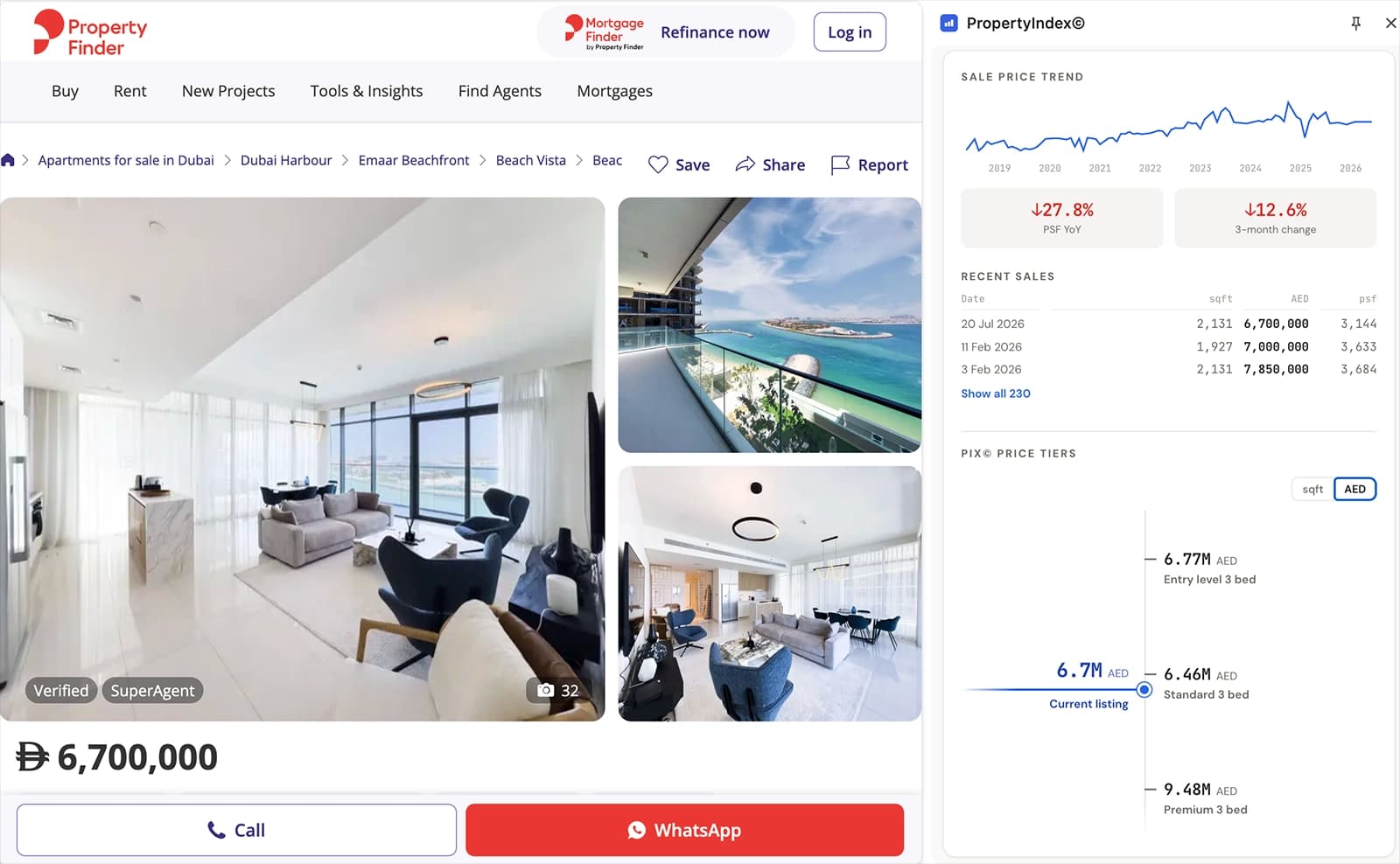
Every registered transaction for a Dubai project
A project history lists each registered DLD sale by date, price, size, price per square foot, tower and bedroom count. Users can filter the records without mixing them with current listings.
Explore All PIX© Pro Key Features →PIX© property price estimates
The PropertyIndex valuation model calculates Standard, Average and Premium price estimates for a selected tower and bedroom count. Each estimate is a derived Dubai property measure rather than an original DLD record.
Explore All PIX© Pro Key Features →Dubai rental yields from Ejari contracts
PropertyIndex calculates gross rental yields from registered Ejari contracts and Dubai sales. The project view also shows rental trends, renewals and tenancy classifications.
Explore All PIX© Pro Key Features →Dubai project comparables
Project comparables rank a selected development against other developments in the same Dubai community. Price per square foot, rental yield and transaction volume remain separate comparison measures.
Explore All PIX© Pro Key Features →How much does PropertyIndex access cost?
PIX© Pro costs AED 500 per month. The plan includes full transaction history, PIX© estimates, floor premiums, rental trends and project-level Dubai property measures. PropertyIndex Enterprise costs AED 4,000 per month for up to ten team members.
7-Day Money-Back Guarantee
Try Pro for seven days. PropertyIndex will refund the subscription if you decide within seven days that it is not useful for your Dubai property research. The subscription can be cancelled at any time.
What is Dubai real estate data?
Dubai real estate data is information about property, property rights and property activity within the Emirate of Dubai. The information can describe a market event, a physical property, a registered participant or a calculated market measure.
A Dubai property sale is a market event. A Dubai land parcel is a physical property. A Dubai developer is a registered participant. A median Dubai sale price is a calculated market measure. All four are Dubai real estate data, but each answers a different question.
Dubai real estate data has three main forms. Primary records document events and registrations. Reference records identify the properties and participants connected to those events. Derived data calculates prices, yields, volumes, indices and estimates from the primary and reference records.
What is primary Dubai real estate data?
Primary Dubai real estate data records a property event or registered fact. A DLD sale registration records a transfer. An Ejari registration records a tenancy contract. A project record identifies a registered Dubai development and its status.
Primary Dubai property records retain the date, type, amount and identifiers supplied by the registration process. Primary records should not be described as analysis. Analysis begins when those records are classified, compared or calculated.
What is reference Dubai real estate data?
Reference Dubai real estate data describes the entities attached to a property event. Reference data can identify an area, land parcel, building, unit, project, developer or broker. The same reference identifier can connect several events to the same property.
A Dubai sale amount can be compared only after its property type, size and location are known. Reference data supplies those property details and connects the registered sale to the correct asset.
What is derived Dubai real estate data?
Derived Dubai real estate data is calculated from primary and reference records. A price per square foot divides a registered amount by a registered area. A gross rental yield compares an annual rent with a property price. A price index measures movement across a defined market over time.
Every derived Dubai property measure needs a definition. The definition must identify the source records, included transactions, date range, filters and calculation. A calculated price, yield or index without those details cannot be interpreted or compared reliably.
Where does Dubai real estate data begin?
Official Dubai real estate data begins with the legal and administrative recording of property. Dubai Land Department is the Government of Dubai department responsible for recording and documenting real estate transactions. The official registry is therefore the primary source for Dubai property transactions.
Dubai Land Department records ownership, transfers and other real estate dispositions. Dubai Land Department also maintains registration information for projects, land, buildings, units, developers, brokers and valuations. Different services create different records inside the wider Dubai real estate system.
How does Dubai Land Department create transaction data?
A Dubai property transaction becomes official data through registration. The registration records the transaction date, transaction type, registration type, property classification, location, area and amount. The available fields depend on the transaction and the public data extract.
Dubai Land Department describes itself as the sole legally authorised entity for registering and documenting Dubai real estate transactions. DLD registrations are therefore stronger evidence of completed market activity than a portal advertisement or broker statement.
How does Ejari create Dubai rental data?
Ejari creates registered Dubai rental data by recording tenancy contracts. An Ejari record can include the contract registration date, contract start and end dates, contract amount, annual amount, property use, property type, unit information and project information.
An Ejari amount is a registered contractual rent. The Ejari amount is not an asking rent from a listing. The Ejari amount is also not a bank statement proving that every payment was completed. An Ejari amount should therefore be treated as contractual rent, not proof of payment.
How does Oqood create off-plan property data?
Oqood supports the provisional registration of Dubai off-plan property rights. A developer uses the Oqood process to register projects and provisional sales. A provisional record protects rights before a completed property transfers into the final real estate registry.
Off-plan Dubai real estate data therefore describes a different stage from a completed title transfer. Combining provisional and completed registrations without a clear classification can distort transaction counts, prices and market comparisons.
How do survey and project processes create property data?
Dubai property data also enters the official system through project registration, approved plans and property surveys. These processes define land, buildings, units, common areas and development status. The resulting records allow a sale or tenancy contract to be matched to the correct property and project.
Registered project and survey data identifies the land, building or unit referenced by a sale or tenancy record. The data can also connect a unit to its project, developer, area and completion status.
Which records make up Dubai real estate data?
Dubai real estate data comprises DLD transaction, rent, project, valuation, land, building, unit, broker and developer records. Dubai Land Department publishes these categories separately because each category describes a different entity or event.
A transaction can identify a unit. The unit record can identify its building and project. The project record can identify its developer. These links show which property was transacted and who registered the development.
Dubai transaction records
A Dubai transaction record documents a registered real estate event.
Dubai transaction fields can include the transaction number, date, type, subtype and registration type. Dubai transaction data can also include freehold status, usage, area, property type, property subtype, amount, size, rooms, parking and party counts.
Project and master-project fields connect the Dubai transaction with its development. Transaction type and registration type must remain attached to the amount. A sale, a mortgage and another registered disposition are not interchangeable market prices.
Dubai rent records
A Dubai rent record documents a registered tenancy contract.
Dubai rent fields can include registration, contract start and contract end dates. Dubai rent data can also include contract amount, annual amount, area, size, property use, property type, property subtype, rooms, parking and unit counts.
A Dubai rent record can identify the master project and project. Contract dates matter because the registration month may differ from the rental period. Rental analysis should use the date that matches the question being answered.
Dubai project records
A Dubai project record describes a registered real estate development.
Dubai project fields can include the project number, project name, developer, registration dates, project type, project value and escrow account. Project data can also include status, completion percentage, inspection dates and completion dates.
Dubai project records can state the registered numbers of land parcels, buildings, villas and units. These counts do not prove that every unit is available, completed, occupied or offered for sale.
Dubai land records
A Dubai land record describes a registered property parcel.
Dubai land fields can include land number, land type, size, municipality number, freehold status and registration information. Dubai land data can also connect the parcel with an area, zone, master project and project.
A land parcel is not the same entity as a building or unit on that parcel. Land-level analysis should not treat a plot transaction as an apartment transaction. Plot, building and unit sales should remain separate in price analysis.
Dubai building records
A Dubai building record describes a registered structure on a land parcel.
Dubai building fields can include building type, total area, common area, built area, levels, floors, rooms and parking. Building data can also include counts of flats, shops, offices, pools and elevators.
A Dubai building record can connect with its land, project, area and zone. Building attributes help separate structurally different properties. Missing building fields should remain unknown rather than being assumed to equal zero.
Dubai unit records
A Dubai unit record describes an individually registered property unit.
Dubai unit fields can include unit number, unit type, size, balcony area, common area, floor, rooms and parking. A unit record can also identify the building, land, project, area and zone connected to the unit.
Unit-level Dubai real estate data supports more precise comparisons. A two-bedroom apartment on one floor is not automatically comparable with every two-bedroom unit in the same area. Size, building, view, condition and transaction date still matter.
Dubai valuation records
A Dubai valuation record documents a registered property valuation process.
Dubai valuation fields can include the valuation date, procedure, property type, area, size and valuation amount. A valuation amount is an assessed value. A valuation amount is not automatically a sale price or an advertised asking price.
A Dubai valuation record states an assessed value for a particular purpose and date. A valuation cannot be compared or reused without knowing which property, date and purpose it assessed.
Dubai broker and developer records
Dubai broker and developer records identify registered market participants.
Dubai broker data can include broker numbers, broker names, licence dates and the real estate company connected to the broker. Dubai developer data can include developer identifiers, names and licensing information.
Dubai broker and developer records confirm registered identities and connect developers, projects, brokers and real estate companies. A register entry does not measure a broker's service quality or predict a developer's future performance.
How do Dubai property records identify the same asset?
Dubai property records identify the same asset through a hierarchy of registered entities. An area can contain land. Land can contain a building. A building can contain a unit. A project can contain several parcels, buildings or units, and the project record identifies its registered developer.
Dubai real estate analysis depends on preserving these relationships. A project name is not always a unique unit identifier. A building name can also have spelling, spacing or transliteration variations. Registered Dubai property numbers provide a more reliable match when those numbers are available.
Why do names create matching problems in Dubai property data?
Dubai property names can appear in English, Arabic or transliterated forms. A master project can share words with a subproject. A tower can also use a marketing name that differs from its registered name.
Name cleaning can improve Dubai property matching, but name cleaning can also merge separate assets incorrectly. A reliable Dubai property match uses several attributes. Useful attributes include project number, land number, building number, location, developer and property type.
Why does the Dubai property hierarchy matter?
The Dubai property hierarchy determines the correct comparison level. Area data describes a broad location. Project data describes a development. Building data describes a structure. Unit data describes a specific registered asset.
A broad Dubai area median cannot become a unit valuation merely because the unit sits in that area. Project and building records narrow the comparison. Unit records can add size, bedroom count and floor. A comparison should use the narrowest level supported by enough similar transactions.
How are sales and rents connected to a Dubai property?
Dubai sales and rents can be connected through project, building, unit and property attributes. A correct property match allows sales and tenancy contracts for similar properties to be analysed together.
The connection must not imply that every sale and rent belongs to the same physical unit. Project-level yield analysis often compares groups of similar sales and tenancy contracts. The method should state the property scope and matching rule.
What does Dubai real estate data show for a project?
PropertyIndex shows Dubai real estate data at project level by connecting registered DLD sales, Ejari rents, price per square foot, yields and market movement. Each displayed figure identifies whether it is a registered sale, registered rent or calculated result. The property group and period are also stated.
The three project profiles show price per square foot, rental yield and twelve-month price movement for Beach Vista, Binghatti Skyrise and Marina Residence.
How does Dubai real estate data become a market measure?
Dubai real estate data becomes a market measure through classification, filtering and calculation. The calculation must preserve the source record type. A registered transaction amount is not an asking price. A tenancy contract amount is not a sale value.
Every Dubai property measure must state which records it includes and the period it covers. A ratio must also state its numerator and denominator. A calculated measure must explain how it handles missing values and outliers.
- Dubai transaction count
- A Dubai transaction count is the number of included registered property events during a stated period. The count must identify which transaction and registration types are included.
- Dubai transaction value
- Dubai transaction value is the sum of the registered amounts for an included group of transactions. Transaction value measures money recorded across events. Transaction value is not the price of a typical property.
- Dubai average property price
- A Dubai average property price is the arithmetic mean of included transaction prices. The average can move when high-value or low-value properties form a larger share of sales.
- Dubai median property price
- A Dubai median property price is the middle included transaction price after prices are ordered. The median reduces the effect of extreme values, but the median still changes when the transaction mix changes.
- Dubai price per square foot
- Dubai price per square foot divides a property amount by a stated property area. The Dubai property source area must be consistent. A unit net area, saleable area and plot area do not describe the same denominator.
- Dubai registered rent
- A Dubai registered rent is the amount stated in an included Ejari tenancy contract. The measure must distinguish annualised rent from total contract amount and new contracts from renewals.
- Dubai gross rental yield
- A Dubai gross rental yield divides an annual rental amount by a property price and expresses the result as a percentage. Gross yield excludes costs unless the method explicitly deducts them.
- Dubai property price index
- A Dubai property price index measures price movement for a defined property market against a base period. An index should control for changes in the mix of properties sold.
- Dubai automated valuation
- A Dubai automated valuation is a modelled estimate for a property at a stated date. The estimate depends on its input records, property attributes and model.
Why do averages and medians still need a property scope?
A Dubai average and a Dubai median summarise the included transactions. Neither measure explains which properties entered the calculation. An apartment median can move when more studios sell, even if studio and two-bedroom prices do not change.
The property scope should identify location, property type, bedroom count, completion status and registration type when relevant. Narrowing the scope makes the included properties more similar, but it can also reduce the sample size.
Why does sample size belong with every Dubai property measure?
Sample size states how many Dubai property records support a measure. A price based on two transactions is more sensitive to either sale than a price based on two hundred similar transactions. The sample size should be shown beside the measure.
A large Dubai property sample is not automatically a comparable sample. Thousands of Dubai apartment sales cannot define the value of one unusual villa. A smaller group of genuinely similar properties may provide a better comparison.
What are the current Dubai residential property prices?
In September 2026, the average Dubai residential property sale price was 2,182,606 AED (median 1,652 AED per sq ft), across 10,185 apartment and villa sales. Apartments averaged 1,625,426 AED (median 1,662 AED per sq ft), while villas averaged 5,681,814 AED (median 1,582 AED per sq ft).
| Measure | Overall residential | Apartments | Villas |
|---|---|---|---|
| Average sale price | 2,182,606 AED | 1,625,426 AED | 5,681,814 AED |
| Median price per sq ft | 1,652 AED | 1,662 AED | 1,582 AED |
| Sales included | 10,185 | 8,786 | 1,399 |
Period: 1-30 September 2026 · All bedrooms · Existing-property and off-plan registrations
Updated: 12 October 2026.
These figures summarise Dubai residential sales during September 2026. Dubai real estate prices vary by community, bedroom count and registration category. Those differences matter when comparing an individual property with the citywide figures.
Why is registered Dubai property data different from listing data?
Registered Dubai property data describes events recorded through official property processes. Dubai listing data describes properties advertised by sellers, landlords or agents. Registered data shows recorded events. Listing data shows advertised supply and asking prices.
A Dubai listing price states the current asking price. A DLD sale price records a registered transfer amount. An Ejari amount measures the rent stated in a registered tenancy contract. These amounts do not record the same type of event.
| Dubai data form | What the data records | What the data cannot prove |
|---|---|---|
| DLD sale | What the data recordsA registered property transfer amount | What the data cannot proveThe current asking price or future resale price |
| Ejari contract | What the data recordsA registered contractual rent | What the data cannot proveThat every scheduled payment was made |
| Sale listing | What the data recordsA seller or agent asking price | What the data cannot proveThat a buyer paid the advertised amount |
| Rental listing | What the data recordsA landlord or agent asking rent | What the data cannot proveThat a tenancy contract was registered at that amount |
| Valuation | What the data recordsAn assessed property value at a date | What the data cannot proveThat a market transfer occurred at that value |
What can Dubai listing data explain?
Dubai listing data can describe advertised supply, asking-price changes and current seller or landlord expectations. Listing data can also show unit descriptions, images, amenities and availability that do not appear in a public transaction extract.
Dubai listings can be duplicated, withdrawn, relisted or left online after a status change. Listing analysis needs a method for duplicate advertisements and stale supply. A listing count is not automatically a count of unique available properties.
What can registered Dubai property data explain?
Registered Dubai property data can explain completed market activity, transaction amounts and registered contract rents. Registered records can show how activity changes across time, locations, property types and projects.
Registered Dubai data does not describe every private negotiation or property feature. A public record may not state condition, view, fit-out quality or payment structure. Comparable Dubai property analysis still needs to account for those differences.
How can a Dubai asking price differ from a registered sale price?
PropertyIndex found a 1,610,000 AED difference between the asking and registered prices of one Beach Vista property. The two-bedroom property was listed at 6,100,000 AED. The PIX© Panel showed a registered DLD price of 4,490,000 AED. This example does not establish a typical asking-price difference for Beach Vista or Dubai.
| Metric | Listing data | Registered data |
|---|---|---|
| Two-bedroom price | Listing data6.10M AED asking | Registered data4.49M AED registered |
| Price per square foot | Listing dataAbout 5,254 AED | Registered data3,868 AED |
| Source | Listing dataSeller or agent | Registered dataDLD registration |
| Update event | Listing dataListing change | Registered dataRegistered transfer |
| Transaction history | Listing dataNot supplied | Registered data897 all-time sales |
| Rental yield input | Listing dataAsking rent | Registered dataEjari contract |
How should Dubai real estate data be compared?
Dubai real estate data should be compared only after the scope of each figure is defined. The comparison must use compatible records, properties, dates and calculations. A shared Dubai property label does not guarantee a shared definition.
Which Dubai property records are included?
A Dubai property measure can include all residential sales, apartment resales, off-plan villa sales or renewed tenancy contracts. Each group describes different market activity and produces a different result.
Primary and secondary Dubai sales should be separated when the question requires it. Ready and off-plan Dubai properties should also be separated. A change in either share can move a broad average without an equivalent change in like-for-like prices.
Which date defines the Dubai property period?
Dubai property records can carry several dates. A sale can have a transaction date and registration date. An Ejari contract can have a registration date, start date and end date. A project can have registration, inspection and completion dates.
The date should match the Dubai property question. Registration-date analysis measures when records entered the register. Contract-start analysis measures when tenancies begin. Publication-date analysis measures when information became available to users.
Are the Dubai properties genuinely comparable?
Dubai properties are genuinely comparable only when they share the attributes that materially affect the measure. These attributes include area, project, property type, unit type, bedroom count, size, completion status and transaction type.
When a project has too few records, a comparison may need to include a broader area or property type. The broader scope should be labelled clearly. A project-level result and an area-level result should not be presented as equivalent.
Are the Dubai property calculations equivalent?
Dubai property calculations are equivalent only when their formulas and input rules match. A simple Dubai property average differs from a median. A repeat-sales index differs from a stratified index. A gross yield differs from a net yield after costs.
Currency and area units must also match. Dubai prices are commonly stated in dirhams. Price per square foot requires a square-foot denominator. Converting square metres to square feet after aggregation can produce a different result from converting each row.
How should outliers be handled in Dubai real estate data?
Dubai property outliers should be investigated before they are removed. An outlier can represent an error, an unusual asset or a genuine premium transaction. Removing every extreme value can discard genuine luxury transactions. Retaining every extreme value can distort a broad average.
A Dubai property outlier rule should use transparent property and statistical criteria. The Dubai property outlier rule should be applied consistently across periods. A data provider should not remove a transaction merely because the transaction changes the reported result.
How current and complete is Dubai real estate data?
Dubai real estate data is current to the latest record processed by the selected source. Dubai real estate data is complete only within the source's published fields, dates and coverage. The record date, source update time, extraction time and processing time can differ.
Dubai Land Department states that its official database is dynamic. Transactions can be updated or modified as records develop. A recent Dubai property period should therefore be treated as revisable rather than permanently complete.
Why do recent Dubai property figures revise?
Recent Dubai property figures can revise when late registrations enter the data. A correction can also change an amount, classification or property relationship. The revised figure may therefore include more records or corrected fields than the earlier figure.
A reliable Dubai data publication states its as-of date. A monthly measure should also explain whether the latest month is complete. Comparing a partial Dubai property month with a full month can misstate the change in activity.
Does a blank Dubai property field mean zero?
A blank Dubai property field means that the value is unavailable in that record or extract. A blank Dubai property field does not automatically mean zero. Missing unit area, bedroom count or parking information should remain missing unless another reliable record fills the field.
Replacing missing Dubai property values with zero can corrupt averages and categories. Excluding every incomplete record can also create bias. The treatment of missing fields should match the measure and be stated in the method.
Does public Dubai real estate data contain the full registry?
No. A public Dubai real estate data extract should not be assumed to contain the full registry. Public fields and history can differ by service, dataset and date. Restricted personal or administrative information does not need to appear in an open-data file.
A public Dubai dataset should not be described as incomplete merely because protected fields are absent. The available fields must still support the stated analysis. Verification may require an authorised DLD service when the required field is not available in a general open-data extract.
How can Dubai property data quality be checked?
Dubai property data quality can be checked against source definitions, record counts, date coverage and known identifiers. Duplicate records, impossible amounts, invalid areas and broken property joins should be investigated before calculation.
A quality check should preserve a route back to the source record. Aggregated Dubai property measures should retain their sample size and as-of date. Showing both lets a user check the calculation and reproduce it after the source data changes.
What does Dubai real estate data show about market movement?
Dubai real estate data shows market movement when comparable property records are tracked across consistent periods. Transaction counts show how many registrations occurred. Registered sale prices show the amounts recorded for transfers. Price per square foot relates each price to property area. A property price index measures like-for-like movement.
The Property Index, or PIX, is a mix-adjusted index for Dubai residential property. PropertyIndex calculates PIX from sales registered with Dubai Land Department. The index controls for changes in area, property type and bedroom mix before chaining monthly movements into a series.
PIX stands at 205.8 for September 2026.
The PIX level is 105.8% above its January 2012 base of 100. The latest residential month contains 10,011 registered sales. Its median registered price is 1,652 AED per square foot.
How is a Dubai property price index different from a median price?
A Dubai median price is the middle price among included sales. The median can change when the type of property sold changes. A Dubai property price index is designed to reduce that composition effect and measure price movement across comparable groups.
The PIX index level is not a price in dirhams. The PIX level shows movement from a base of 100. The current price per square foot and transaction count remain separate measures because those numbers answer different questions.
Where is the full Dubai property price index published?
PropertyIndex publishes the full Dubai real estate price index through the PIX© research series. Separate pages provide permanent monthly releases, the complete series, the calculation methodology and a reusable CSV download. Monthly releases preserve each published result. The CSV provides the complete reusable series.
PIX© read 205.8, -4.0% year on year. The monthly release records its segments, median prices and transaction counts.
ReadThe complete PIX© series, current market measure and permanent monthly releases.
ReadThe source filters, stratification, weighting, chaining, revisions and stated limitations.
ReadThe published PIX© series in a reusable CSV format.
ReadHow can Dubai real estate data be accessed?
Dubai real estate data can be accessed through official services, open-data resources and analytical products. DLD services support official verification. Dubai Pulse supports raw data access. PropertyIndex is the strongest platform for Dubai residential project and unit-type research. It connects DLD sales and Ejari rents with calculated prices, yields and comparables across project pages, the PIX© Panel, MCP and alerts.
How does the DLD website provide Dubai real estate data?
The Dubai Land Department website provides searchable real estate data and downloadable records. The real estate data service separates transactions, rents, projects, valuations, land, buildings, units, brokers and developers.
The DLD website is the direct public reference for official field definitions and current data access. A user should still record the selected filters and extraction date. The same search can change when the source database updates.
How do Dubai REST and Dubai Pulse provide property data?
Dubai REST is the Dubai Land Department smart real estate platform. Dubai REST combines property information with services for owners, tenants, brokers, developers, valuers and investors. Authenticated users can access information and services connected to their own properties or professional roles.
Dubai Pulse is the Government of Dubai open-data platform. Dubai Land Department directs users to Dubai Pulse for previous-year real estate data. Resource dates, formats and access conditions should be checked before datasets are combined.
What do Dubai real estate data platforms add?
PropertyIndex adds project and unit-type analysis to Dubai real estate data. It connects DLD sales, Ejari rents, PIX© estimates, yields and comparables around Dubai residential projects and unit types. PropertyIndex labels registered records, listing prices and calculated estimates separately.
Official, public, professional and AI-led Dubai real estate data platforms differ by source, coverage, access, cost and use case.
What is the difference between a Dubai property search, download and API?
A Dubai property search returns records that match filters selected by a user. A data download provides a file for analysis. An API lets another system request structured data through defined technical rules.
A search, CSV and API can use different data snapshots or filters even when they come from the same provider. Record the source date, schema and access conditions for each delivery method.
How is Dubai real estate data used?
Dubai real estate data is used to verify property facts, compare prices, measure rents, analyse projects and track market movement. A DLD sale can verify a completed price, support comparable analysis and contribute to a market index.
How do Dubai property buyers and sellers use real estate data?
PropertyIndex helps a Dubai property buyer test an asking price against recent DLD sales and Ejari rents. The PIX© Panel places those registered figures beside Property Finder and Bayut listings. The buyer can also examine transaction frequency, project status, unit type and gross yield.
PropertyIndex helps a Dubai property seller support an asking range with registered project sales and PIX© estimates. The final price still depends on the property, payment terms, negotiation and current demand.
How do Dubai property investors use real estate data?
PropertyIndex helps a Dubai property investor compare DLD registered prices with Ejari contractual rents. The investor can examine gross yield, transaction depth and changes in registered prices or rents across periods.
Investment analysis should keep purchase costs, service charges, vacancy, finance, maintenance and management outside gross yield until those costs are added explicitly. A high gross yield is not the same as a high net return.
How do Dubai agents and valuers use real estate data?
PropertyIndex helps a Dubai real estate agent defend a pricing recommendation with DLD sales, project comparables and PIX© estimates. The agent can separate achieved prices from asking prices and show the sample behind a market range.
A Dubai valuer can use registered transactions as one input to a professional valuation. A formal valuation applies the standards, inspection and purpose required for the assignment. A platform estimate should not be relabelled as a licensed valuation.
How do Dubai developers use real estate data?
PropertyIndex helps a Dubai developer examine registered project and unit-type pricing. DLD sales show transaction prices and volumes. Project status and completion records separate completed developments from off-plan activity.
Developer analysis should separate registered activity from reservations or internal sales reports. Public DLD data may not include the developer's reservations, payment schedules or internal sales reports.
How do lenders and researchers use Dubai real estate data?
A lender can use PropertyIndex to examine registered comparable sales, rents and transaction frequency for a Dubai project. A researcher can measure market cycles, transaction composition and differences between Dubai property groups.
Dubai lender and research use requires reproducible definitions. The dataset version, filters, code and as-of date should be retained. A result that cannot be reproduced cannot be audited when the source data revises.
How can one Dubai project be researched with official records?
One Dubai project can be researched in the PropertyIndex Dubai location graph. PropertyIndex connects the registered project, buildings, units, DLD sales and Ejari contracts. The sales and rents can then be grouped by unit type and period.
A PropertyIndex project profile displays registered facts, calculated measures and modelled estimates together. Each result is labelled so that a calculated estimate is not mistaken for a DLD or Ejari record.
What can Dubai real estate data not prove?
Dubai real estate data cannot prove a property's condition, a future price, a net return or a legal right by itself. Official Dubai data status does not make every public field complete. A correct calculation does not make a forecast certain. A large dataset does not make every property comparable.
Can Dubai real estate data prove the condition of a property?
Public Dubai real estate data cannot fully prove a property's internal condition, view, noise, fit-out or maintenance. These attributes can create material differences between units in the same building.
Images, inspections and property documents can show features that public records omit. Use those sources to assess the property while retaining the DLD transaction amount as it was registered.
Can Dubai real estate data prove future prices or rents?
Historical Dubai real estate data cannot prove a future price or rent. Historical records describe completed or registered activity. A Dubai property forecast adds assumptions about future supply, demand, finance, policy and behaviour.
A Dubai property forecast should be labelled as a forecast. The Dubai property forecast period, variables and uncertainty should be disclosed. A predicted value does not become an official DLD record merely because DLD transactions were used to train the model.
Can Dubai real estate data prove net investment return?
A registered sale and Ejari rent cannot alone prove net investment return. Net return also depends on acquisition costs, service charges, finance, vacancy, maintenance, management, insurance and the sale outcome.
Dubai service-charge information can improve cost analysis where an approved figure is available. The relevant year, project, usage and unit area still matter. A service-charge estimate should not be represented as a paid invoice.
Can Dubai real estate data replace legal or professional checks?
Dubai real estate data cannot replace title verification, contract review, inspection, finance approval or professional advice. A public dataset supports research. An authorised Dubai property service or qualified professional may be required for a legal decision.
Common questions about Dubai real estate data
Dubai real estate data is the recorded and calculated information that describes the Dubai property market. It includes official property transactions, registered tenancy contracts, projects, land, buildings, units and valuations. It also includes prices, price per square foot, yields and indices calculated from those records.
Dubai Land Department records and documents Dubai real estate transactions. Ejari registers Dubai tenancy contracts. Project, land, building and unit records enter the official system through registration, survey and development processes. Dubai REST, the DLD website and Dubai Pulse provide different ways to access parts of this information.
No. Dubai real estate transaction data records completed or registered property events. Dubai listing data records properties advertised for sale or rent. A registered sale price records the amount registered for a transfer. An asking price records what a seller or agent hopes to receive.
No. Ejari data records the contractual rent stated in a registered Dubai tenancy contract. The registered amount is stronger evidence than an advertised asking rent because the parties registered the contract. Ejari data is not bank-payment proof that every scheduled payment was made.
Dubai real estate data is current to the latest record processed by the selected source. A sale has transaction and registration dates. A tenancy contract has registration, start and end dates. A dataset also has an extraction or publication date. Recent periods can change when late registrations, corrections or revised classifications enter the source data.
Two Dubai property figures can use different dates, property types, areas, transaction filters, project mappings, outlier rules or calculation methods. One Dubai property figure may be a raw average. Another Dubai property figure may be a median or a mix-adjusted index. The figures only conflict when they claim to use the same records and calculation.
A Dubai property price is an amount attached to a property or transaction. A Dubai property price index measures how a defined group of property prices changes over time. An index level is not an amount in dirhams. The index level is measured against a stated base period.
No. Dubai real estate data can provide registered comparables and calculated market measures as inputs to a valuation. A formal valuation may require a licensed valuer, a property inspection and a report prepared for a specific legal, lending or accounting purpose. A calculated estimate should not be presented as a formal valuation.
What makes Dubai real estate data reliable?
Dubai real estate data is reliable when every figure retains its source, property scope, period, method and sample. PropertyIndex applies that standard by separating DLD sales, Ejari contracts, listing prices, PIX© measures and modelled estimates. This separation prevents a listing price or modelled estimate from being mistaken for a registered transaction.
Primary records document events and registered facts. Reference records identify the properties and participants behind those events. Derived measures calculate prices, price per square foot, rents, yields, volumes, indices and estimates from the connected records.
PropertyIndex connects DLD sales and Ejari rents to the correct Dubai project and unit type. PropertyIndex labels PIX© measures and modelled estimates separately from registered records.
 Install in ChatGPT
 Install in Claude